

When most travelers think of Ha Giang, they picture rugged limestone peaks and winding mountain passes. But beyond the dramatic cliffs and thrilling roads lies another hidden treasure — the terraced rice fields.
These green and golden landscapes are not only breathtaking to behold but also a living reflection of the mountain people’s harmony with nature.
Whether you’re trekking through remote valleys or exploring the famous Ha Giang Loop, the rice fields here reveal a softer, more tranquil side of Vietnam’s wild north.
Here’s your complete guide to the six best places to see rice fields in Ha Giang, along with the best time to visit and tips for a meaningful, responsible experience.
When Is the Best Time to See Rice Fields in Ha Giang?
Ha Giang shares a similar agricultural rhythm with Sapa — with one main rice harvest season per year. The landscapes transform beautifully throughout the year, and each stage has its own charm:
-
April – May: Water pouring season. Terraces turn into giant mirrors reflecting the sky and clouds.
-
June – August: Green season. The rice grows lush and vibrant, carpeting the mountainsides.
-
September – October: Harvest season. The fields glow golden yellow, alive with farmers cutting rice by hand.
Best time to visit:
-
May for mirror-like reflections after planting
-
August – September for golden harvest scenes
1. Hoang Su Phi – The Kingdom of Terraced Fields
If you see only one rice field region in Ha Giang, make it Hoang Su Phi. This area, tucked deep in the western mountains bordering Lao Cai, is home to Vietnam’s most spectacular terraced fields — vast, sweeping layers carved into steep mountain slopes over centuries.
Here, every curve of the terrace tells a story of resilience. The ethnic Dao, Nung, and Hmong communities have cultivated these fields for generations, creating an awe-inspiring harmony between humans and nature.
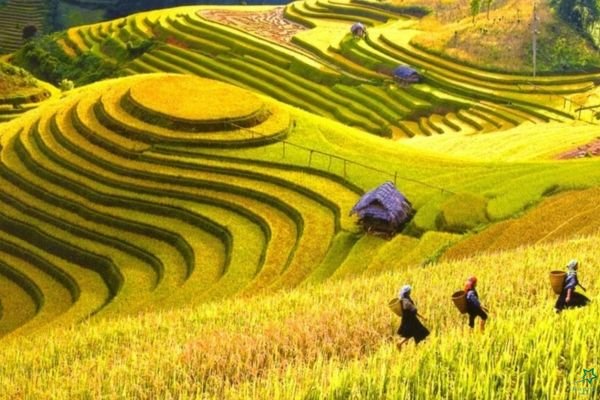
Trekking through Hoang Su Phi is a photographer’s dream and a traveler’s meditation. Villages like Ban Phung, Ban Luoc, and Phin Ho offer unforgettable homestay experiences where you can watch mist drift through the valleys at sunrise.
Best time: August to early October (harvest season)
Experience tip: Spend 2–3 days trekking across villages, staying overnight in wooden stilt houses run by local families.
2. Xin Man – A Hidden Gem Near the Border
Further west from Hoang Su Phi lies Xin Man, a remote region few travelers reach — and that’s precisely what makes it so special.
The landscape here is wild and unspoiled. The rice terraces cascade down the slopes below Kieu Lieu Ti Mountain, one of Ha Giang’s highest peaks. The winding roads to reach Xin Man may test your nerves, but the reward is solitude, silence, and beauty untouched by tourism.
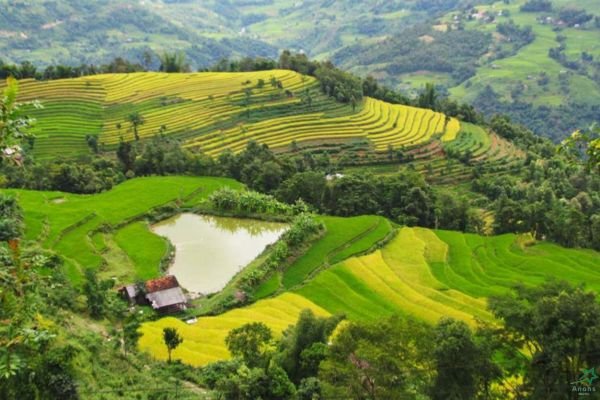
Here, time seems to slow down. You can sit on a hilltop watching clouds roll across the valley while the sound of buffalo bells echoes in the distance.
Insider tip: Combine Xin Man and Hoang Su Phi in a single journey for a deeper look at Ha Giang’s western side.
3. Mau Due – Golden Fields on the Ha Giang Loop
If you’re exploring the famous Ha Giang Loop, Mau Due is one of the best stops to admire terraced rice fields without leaving the main route.
Located between Meo Vac and Ha Giang City, Mau Due surprises visitors with its golden terraces clinging to steep, rocky mountainsides — proof that life thrives even in the harshest conditions.
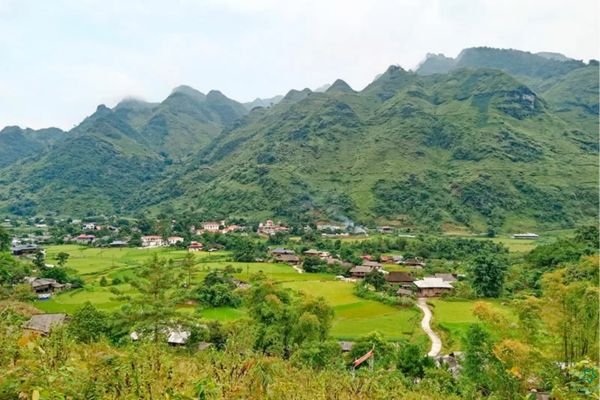
During harvest season, the smell of ripe rice fills the air, and farmers in colorful clothes work from dawn till dusk. The contrast between limestone peaks and golden terraces makes it one of the most photogenic spots on the loop.
Suggested route: Ha Giang → Yen Minh → Dong Van → Meo Vac → Mau Due → Du Gia → Ha Giang
Tip: Stop by a local café or homestay for a mountain-view lunch.
4. Du Gia – The Peaceful Valley of Green Rice Fields
Unlike the terraced mountains of Hoang Su Phi, Du Gia charms with its flat, lush rice valleys surrounded by soft hills.
This small village, nestled deep within the Ha Giang Loop, has become a beloved stop for travelers seeking tranquility and authenticity. Wooden stilt houses line the stream, and locals from the Tay ethnic group welcome visitors with warm smiles and home-cooked meals.
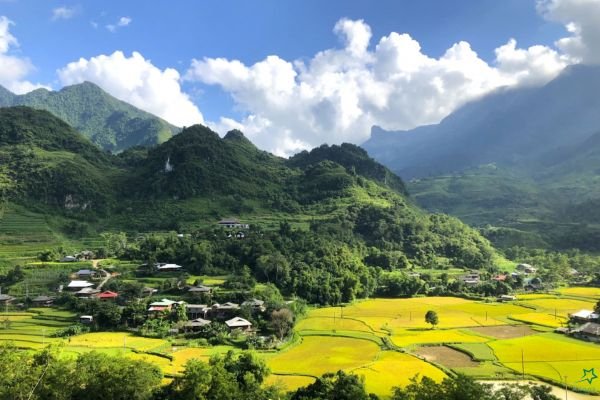
After exploring the rice fields, take a dip in the nearby Du Gia waterfall, or simply sit on a balcony overlooking the paddies while the evening mist rolls in.
Best experience: Stay in a homestay by the river — you’ll wake up to the sound of roosters and the scent of wet earth after rain.
5. Thon Tha – Village Life Near Ha Giang City
Just a short 6 km from Ha Giang City lies Thon Tha, a charming Tay ethnic village where time feels frozen.
The rice fields here are smaller and flatter than the terraced ones up north, but their beauty lies in simplicity — green paddies dotted with grazing buffalo, bamboo fences, and smoke rising from wooden kitchens at dusk.
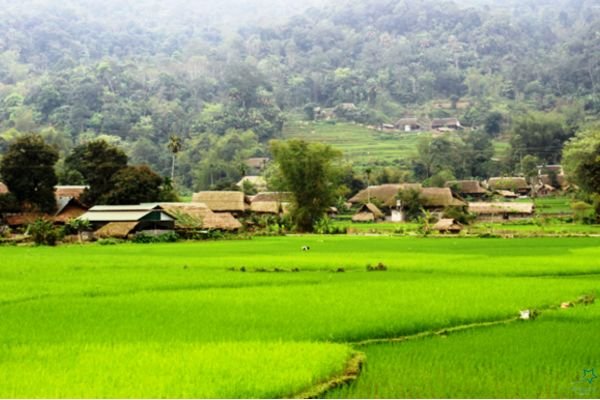
For travelers short on time, Thon Tha offers a glimpse of rural Vietnam without needing to venture far.
Do this: Take a leisurely walk around the fields at sunset, then enjoy a home-cooked dinner at a local homestay.
Or: Rent a motorbike to explore nearby villages and waterfalls.
6. Lung Cu – Rice & Culture at Vietnam’s Northernmost Point
Beyond the flag tower that marks Vietnam’s northern tip, Lung Cu hides a quiet surprise — small rice terraces nestled in valleys surrounded by Lo Lo ethnic villages.
While the terraces here are smaller than those in Hoang Su Phi, their charm comes from the peaceful setting: yellow-clay houses, blooming flower fields, and distant views of the borderlands.
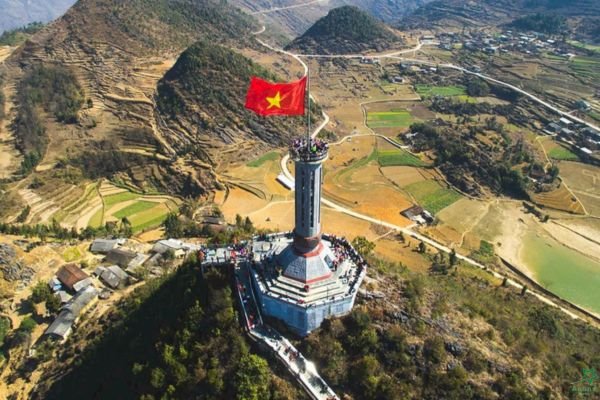
A stay in Lung Cu gives you a chance to experience remote mountain life up close — share tea with locals, learn about traditional weaving, or simply enjoy the silence broken only by the sound of the wind.
Stay tip: Choose a family-run homestay to enjoy both cultural exchange and panoramic rice field views.
Tips for Seeing Rice Fields in Ha Giang
-
Plan your trip for the right season:
Visit May for mirror-like reflections or August–September for golden harvest scenes. -
Hire a local guide:
Many fields are off the beaten path; guides can lead you safely and explain local customs. -
Prepare for the weather:
Bring light rain gear, sturdy shoes, and plenty of water. The harvest season overlaps with mild rain. -
Travel responsibly:
Avoid stepping into the fields, dispose of waste properly, and ask before photographing locals. -
Best time for photos:
Early morning or late afternoon, when sunlight softens and mist lingers over the valleys.
Why Explore Ha Giang with Anan’s Travel
At ananstravel.com, we believe travel is not just about seeing — it’s about feeling.
Our Ha Giang Loop and trekking tours are crafted for travelers who want to connect deeply with nature and culture. We take you beyond the tourist trails — into the rice terraces of Hoang Su Phi, the peaceful valleys of Du Gia, and the remote villages of Lung Cu.
Traveling with us means more than adventure; it means supporting local families, staying in authentic homestays, and witnessing the real beauty of Ha Giang through local eyes.
Final Thoughts
The rice fields of Ha Giang are more than landscapes — they are the living heartbeat of the mountains. From the golden waves of Hoang Su Phi to the tranquil fields of Du Gia, every terrace tells a story of patience, pride, and connection to the land.
When you walk among these terraces, you don’t just see beauty — you feel the rhythm of life that has remained unchanged for centuries.
So, pack your boots, follow the mountain trails, and let Anan’s Travel guide you to the hidden corners where nature and culture dance in harmony.
Plan your journey today at ananstravel.com — and witness Ha Giang’s golden season for yourself.

0 Comment